Pesto for St. Patrick’s Day

cilantro pesto, pesto, meatless, vegetarian, St. Patrick's Day, St. Joseph's Day

Nothing says green like a pesto sauce! The brilliant emerald color comes from cilantro leaves instead of basil. (Photos by Laura Groch 2014)

Happy St. Patrick’s Day! You won’t find a recipe for corned beef or Irish soda bread here today, but I do have a recipe that’s very green. And it’s also kind of Italian, which checks off St. Joseph’s Day (March 19), and it’s meatless, so it works for Lenten Friday meals too.

But I have to warn you, it’s not for everyone. This recipe is for a flavorful pesto Continue reading

Don’t forget the CLIF drawing! Get your comments in

Reminder: If you’d like to enter the drawing for free CLIF bars, the deadline is end of day Saturday, March 15. The CLIF folks are publicizing their new Sierra Trail Mix bars by offering gift packs to three lucky winners. To enter,

CLIF bars, contest, giveaway

Don’t forget to add a comment on the blog for a chance to win free CLIF bars!

just leave a comment on the original blogpost at https://beyondbites.com/2014/02/14/a-winner-and-another-giveaway/ to be entered in the drawing for a free pack of CLIF energy bars! Three winners will be chosen. Good luck!

Stoked about stochasticity: Grapefruit Slam IPA

The label on The Stochasticity Project's Grapefruit Slam IPA.

The label on The Stochasticity Project’s Grapefruit Slam IPA.

Grapefruit Slam IPA. Sounds like something those folks at Stone Brewing in Escondido would do, doesn’t it? This beer, released Feb. 10 in 22-ounce bottles, comes from “The Stochasticity Project,” http://www.stochasticity.com/beers/grapefruit-slam-ipa, and if you like bitter, you’ll probably like this new release. (Check out the label from a distance — see if you see anything familiar in the gridlike pattern on the bottle. Hint: It will be very familiar to drinkers of Stone brews.) The Stone folks seem to be running the publicity, but the beer is registered under Koochenvagner Brewing Company. (Hm. Stone was founded by Greg Koch and Steve Wagner. Just sayin’.)

Grapefruit Slam IPA. Step back a bit and look at the image in the center of the label. Recognize anyone? (Photos courtesy Stochasticity Project)

Grapefruit Slam IPA. Step back a bit and look at the image in the center of the label. Recognize anyone? (Photos courtesy Stochasticity Project)

Anyway, the Project’s web page (www.stochasticity.com) describes the beer as a big-bodied pale ale “marrying hand-zested grapefruit peel with the inherent citrusy biterness of Centennial hops” —  “an intensely citrusy brew.” You should be able to find it at liquor stores all over San Diego County.

The Project answered a few questions via email:

Unusual name, Stochasticity. Where’d it come from?

Stochastic is defined as: random; specifically involving a random variable; involving chance or probability. We didn’t want to limit the beers coming from the Stochasticity Project to any one particular style of beer or specific characteristic. All of the releases will definitely involve a random variable whether it is timing of the beer release, ingredients, or the areas the beer will be available.

Who are the people behind/in charge of the Stochasticity Project? 

Everyone that makes up a brewery — brewers, beer scientists, quality assurance engineers, management, administration etc. Their goal is to develop beer recipes by exploring the science of beer, cutting edge theories and other ideas that govern the direction of this ongoing program.

Why grapefruit, and why such pride in such a bitter beer?  

The essential oils and monoterpenoids, like geraniol and citronellol, which are found in hops often provide aromatic components that are described in professional sensory panels as “citrusy.” Flavors like grapefruit, lemon and/or lime for example. The potential synergy of specific hop varieties with citrus fruit is something that brewers who research unique ingredients, and who focus on combining the art of brewing with science, have been experimenting with for a while.

You say your website is not going to be a forum for passive enthusiasts. What exactly are you going for here, then?

The website shares insight into the science behind boundary-pushing beers and features a plethora of information on how science is furthering the development of craft beer. This website isn’t for the average person just looking for a thirst quenching beverage, it’s for someone (who) wants to learn how the beverage was created and conceptualized.

(c) Laura Groch 2014

A winner, and another giveaway!

I’m happy to announce that Barbara Croonquist of Riverside won the free copy of Murrieta author Linda Amendt’s “Gluten-Free Breakfast, Brunch & Beyond” (Taunton Press, 2013), which I wrote about in September 2013.

Now I’ve got another giveaway for you, this one from CLIF Bars.  (Photo courtesy CLIF Bars)

Image

Not to be left out of the chocolate frenzy for Valentine’s Day, the company’s  newest bar, Sierra Trail Mix, is the first CLIF Bar flavor to be made with sustainably grown cocoa from Rainforest Alliance Certified farms. (Yes, it carries the frog seal on the package.) I’m not saying it’s equivalent to a morsel from See’s or Jer’s — but on the other hand, it’s a lot easier to bring along on a romantic stroll than a two-pound box. ;<)

Each 2.4-ounce energy bar also contains peanuts, organic rolled oats and raisins, among other goodies, and weighs in at 250 calories, 70 from fat. Suggested price is $1.39 per bar.

The CLIF Bar folks are offering three giveaways to readers who post a comment on this beyondbites.blog entry. Add your comment below by March 15, and I’ll choose three at random for a free gift pack of CLIF Bars!

(c) copyright Laura Groch 2014

This post was corrected on Feb. 17, 2014 from its original writing.

Bless these throats

St. Blaise is not the patron saint of cooks — that would be St. Lawrence — but he is the patron saint of throats, which is the main way we experience our food.  (That’s how I’m making this a food-related post, guys.) Today is his feast day, and on this day, Catholic Churches still conduct the annual blessing of throats associated with his memory. (Legend has it he cured a child who was choking on a fishbone.) I went to parochial school for six years, and after morning Mass on Feb. 3, we would line up to receive our individual neck check. Some priests just held two candles together in one hand in the shape of an X; in other parishes, the candles were specially formed to go partly around the neck. The priest held the juncture of the candles briefly to the person’s throat while asking St. Blaise to save us from all related ailments. A comforting ritual, as many rituals are meant to be. I just wanted to give St. Blaise a shout-out and a thank you on his special day!

(c) copyright Laura Groch 2014

Bowl ‘Em Over With Biscuits

Image

Cheddar Buttermilk Biscuits from Amaya La Jolla make a great go-with for your Super Bowl fare, or another dish, or just by themselves with butter. (Photo by Kelley Carlson)

Super Bowl Sunday is coming up fast, and bowls of chili, gumbo, and other warming fare will be on the menu of gatherings across the country. Here’s an idea for a go-with dish — a yummy biscuit I had the good fortune to sample at Amaya La Jolla recently. These Cheddar Buttermilk Biscuits were part of Chef Camron Woods’ delicious roast suckling pig slider appetizers — but they’d also be great supporting players for the abovementioned chili, gumbo, soups, stews, etc.

Biscuits are enjoying a bit of a renaissance (did we all get tired of polenta?), and they’re fairly easy to put together. (Note that the recipe calls for at least 4 hours’ chill time, or overnight, so plan accordingly.)

Here’s the recipe from Amaya La Jolla, courtesy of Pastry Chef Michael Luna. Truth in advertising: I don’t have a kitchen scale, so I made these conversions (in parentheses) with the help of online sources.

CHEDDAR BUTTERMILK BISCUITS

1 pound, 4 ounces White Lilly flour (about 4 1/2 cups)

1 1/2 teaspoons cream of tartar

1/4 cup sugar

2 1/4 teaspoons salt

2 1/4 teaspoons baking soda

1 tablespoon baking powder

4 ounces shortening

6 ounces sharp cheddar cheese, grated

1/4 ounce thyme (1 tablespoon)

15 ounces buttermilk

2 ounces butter, softened

In a large bowl, mix the first six dry ingredients together.

Cut the shortening into this dry mixture by hand, until about pea-sized. Put in freezer overnight or up to 4 hours.

Place the chilled flour mixture into the bowl of an electric mixer. Add the cheddar and thyme and pulse to incorporate. Add the buttermilk in a slow steady stream and mix until fully combined.

Let the dough rest for about 30 minutes, covered in the mixing bowl.

Generously flour the surface of the workstation and roll the dough out to about the size of a 9” x 13” pan.  Spread the butter over 2/3 of the left side of the dough and book-fold once, folding from the left side to the right, leaving enough room to tri-fold from the right side on top of the part that you just folded.

Turn the dough 90 degrees on the table. Proceed to roll out the dough to about 1/4-inch thickness and cut to desired size diameter of biscuits.

Bake at 325 degrees for 20 minutes and brush with butter when they come out of the oven golden brown.

(c) Laura Groch 2014

Thrifty/Nifty: Think at the sink

It’s official: California is once again in the throes of a drought — our worst in about 100 years. We’re being asked to cut water use. Here’s a simple water-saving tip, no matter what state you live in.

We’ve all been guilty of running water into the kitchen sink as we wait for it to warm up (or cool down, depending on Southern California’s season). Next time you finish the contents of a plastic juice or milk jug — preferably a gallon, but two half-gallons will work too — wash it out thoroughly and then sit it by the sink. (Wash and save the lid, too.) Next time you need hot water, run the water into the jug first. I find that after I fill a gallon jug, the water is warm enough (or cool enough) for me.

Cap the jug and use the contents for other things: Fill your coffeemaker or teapot. Fill the pasta or soup pot. Water plants. Replenish your pet’s water dish. I’m sure you’ll come up with more ideas.  That’s a gallon of water saved, and money in my pocket.

I also stash half-gallon jugs of water in my bathroom cabinets for possible emergency use. (That’s about the only emergency supplies I have, but at least it’s something.) I write a date on them with an indelible marker, and then rotate the jugs every few months. I usually use the water on plants, then refill the jugs, redate them, and re-stash them. Save water, save money, and be a little bit more prepared!

Getting to know your inner turkey

Image

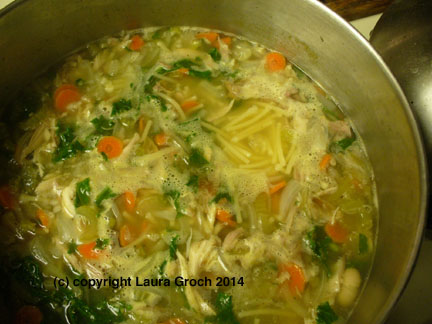
Turkey Soup is a thing of beauty once it’s finished, and you can vary the other ingredients to your liking. Photo by Laura Groch

One of my favorite post-holiday meals is turkey soup. Not only does it taste good, it’s a deserving second act for all the leftover turkey parts. And I do mean parts: the skin, the bones, the drippings, the neck and whatever giblets didn’t end up in the stuffing.

Even if this weren’t National Soup Month, I’d be telling you about making soup from turkey carcasses (sorry, there’s no pretty word to use). To my mind, this is not only thrifty, but respectful. I don’t like waste, and using every last bit seems to me a fitting way to be mindful of what that bird gave up for me.

I’m going to show you a basic recipe you can use all year round: how to boil all the leftover bits together, pull the meat off the bones and strain the broth, which will then become the base for a delicious, warming soup.

What’s nice about making your own soup — besides being able to control what goes into it — is that it’s so adaptable to whatever else is in the fridge. First, you don’t have to make this with turkey. Collect a gallon freezer bag of chicken bones, skin, necks and giblets, and use them. (Tip-Top Meats in Carlsbad sells frozen bags of chicken bones with lots of meat on them for soup-making.)

Second, you can switch around the other ingredients to your liking. Soup is forgiving and flexible. Some good additions:

— A quarter-cup of leftover tomato sauce or a chopped tomato.

— Leftover white beans, zucchini, chopped mushrooms or green beans.

— A couple of spoonfuls of mashed potatoes or cooked squash.

— Leftover gravy.

— Spinach, chard, chopped green cabbage, or frozen sliced okra instead of kale.

— Chopped parsley or cilantro to garnish.

— Cooked rice or barley or kasha instead of pasta.

Third, if you’re cooking for one or two, making a pot of stock or soup gives you lots of options. You can portion out the defatted broth and cooked meat into freezer containers to combine later on with some of the abovementioned veggies and leftovers, or put it all together and then freeze your finished soup in one- or two-serving containers.

To that end, as you prepare your next bird for cooking, save the giblets and neck (if you don’t have another use for them) in a plastic bag and freeze them. Some people cut off the wing tips and discard them, but they’re great to add to the soup pot, so freeze them, too.

After the feast, collect the bones, drippings and any skin scraps. Add them to the giblets, neck, etc., and freeze till you’re ready to make soup. If you have a lot, portion them into several bags — about a half-pound to a pound (about a half-turkey’s worth of bones) to each bag should be ample. Then freeze what you won’t be using right away.

I usually make my broth in a slow cooker, but you can also simmer it in a large pot on the stove. (This is Part 1 of the recipe.)

After encountering bone fragments once too often, I’ve finally learned to strain my broth. I use a wire mesh strainer, not a colander, and strain the broth into a large stockpot. The strainer may hold some pieces you want to keep, such as large pieces of meat, so pick them out and add them to the strained broth. If you’ve used celery, onion, etc., they’ll look pretty limp and unappetizing at this point. Some recipes tell you to discard them with whatever else remains in the strainer. Others tell you to puree them and add back to the soup. Your call. (I go back and forth on this, depending on my mood.)

I usually refrigerate the broth and the bowl of meat to work on the next day. By then, any fat will have congealed on top of the broth, and I can easily scoop it off and dispose of it. (NOT down the garbage disposal. Put it into your regular garbage or freeze it in a disposable container and then throw it out on garbage collection day.)

Next, pick off the meat from the boiled bones and scraps. Here’s where you will really get to know turkey anatomy. It’s a personal challenge to remove every last bit of meat from the bones (and you’d be surprised how much usable meat a turkey neck can yield). The best way to do that, IMHO, is with fingers, not a knife and fork. I usually collect a good cup and a half of meat.

You can stop at this point and freeze everything for a later cooking session. Pack the meat into a freezer bag or a freezer container, and do the same with the defatted broth. (Be sure to label everything!)

Otherwise, keep going with Part 2 of the recipe. Some notes:

— Adjust the seasoning as the soup veggies cook. They throw off some sodium, so it’s best to keep tasting.

— My favorite green in turkey soup is chopped kale. Since the leaves cook quickly, I add it at the end, with the pasta (see below). The stems are sturdier, so I remove them and dice them into about 1/4-inch pieces, then add them with the carrots, onions, etc. (My dog loves inch-long pieces of kale stems as a treat.)

— Pasta is my go-to starch. A small pasta — something that will fit in a spoon — works best. Try little stars, ditalini, orzo, alphabets, small elbows or shells. You can also use short lengths of broken-up spaghetti, or regular noodles. A cup will probably work, but I usually use at least 1 1/2 cups (no doubt compensating for being noodle-deprived as a child).

I hope you enjoy this soup as much as we do, and have fun adapting it to your own taste!

LAURA’S TURKEY SOUP, PART 1

1 turkey carcass, broken into pieces: This includes leftover wing, leg and thigh bones, skin (also neck and giblets if you have them), and skimmed pan juices

8-10 cups water or enough to mostly cover turkey carcass

1 medium onion, chopped

1 rib celery, chopped

1 carrot, chopped

1 clove garlic, chopped

1-2 bay leaves

Combine all ingredients in large slow cooker or large pot on stove. If using slow cooker, cook on Low for 4-6 hours. If using large pot, bring ingredients to a boil, then lower to a simmer, covered, with the lid slightly open. Cook 2-3 hours.

Remove from heat. Using tongs, remove as much of the bones, skin, and meat as possible and put in separate bowl. Refrigerate until cool; then separate meat from bones and shred into small pieces. Discard bones and gristle. Cover and refrigerate meat until ready to use in soup.

Using wire mesh strainer or colander lined with cheesecloth, strain broth into separate large pot or bowl. Pick out pieces of meat from strained ingredients and add to other turkey meat; be careful to remove all bones. If you wish, you can puree the vegetables and add back to the soup; otherwise, discard vegetables and bay leaves. Refrigerate broth until fat has risen to top, then skim fat from surface and discard.

Defatted broth and meat can be frozen for later use. Otherwise, proceed with Part 2.

LAURA’S TURKEY SOUP, PART 2

1 medium onion, chopped

1-2 ribs celery, chopped

1-2 carrots, sliced

1-2 cloves garlic, minced

1 tablespoon olive oil

8 cups turkey broth from Part 1 of recipe

2 teaspoons chicken bouillon

1/4 teaspoon each sage and thyme, rubbed between palms to pulverize leaves

1-2 kale leaves, shredded or torn, with stems removed and finely chopped

1 to 1 1/2 cups noodles or small pasta

In large skillet, saute onion, celery, carrots and garlic in olive oil until soft. Scrape contents of skillet into soup pot with broth from Part 1 of recipe. Add chicken bouillon, sage and thyme, and chopped kale stems. Bring to a boil, then simmer, partly covered, until vegetables are tender, about 30 minutes. Stir in shredded kale leaves and pasta; cook for another 10 minutes, stirring occasionally, until pasta is done. Stir in turkey meat and bring back to a boil. Turn off heat and adjust seasonings. Makes about 10 cups soup.

(c) copyright Laura Groch 2014
Dozens of reasons to enjoy a cookie exchange

Image

Above: The assorted cookies I brought home from our recent cookie swap. For a cookie swap, you bake only one batch but end up with a beautiful assortment of delicious cookies. (Photos by Laura Groch) 

If you’ve never taken part in a cookie exchange before, let me recommend this enjoyable way to share the holiday spirit. And it’s not too late in the season to organize one.

I don’t remember where I first heard about cookie exchanges or cookie swaps, but I do know that the idea immediately struck me as a winner: Bake one batch of cookies, get together with a group of friends, and divvy up the cookies. Go in with snickerdoodles, come out with chocolate chip, peanut blossoms, rugelach, Mexican wedding cakes and more, depending on the group.

I enlisted my officemates to try it out, and it worked so well that we started a December tradition. Not only was it fun, it was efficient and saved buckets of time when everyone was being pulled in several directions at the holidays. This year found me swapping with another group of friends, who were also pleased with the results.

As I said, it’s not too late for you to enjoy the fun, creativity and rewards of doing a cookie exchange. (How about organizing one for a Saturday-or-Sunday-before-New-Year’s get-together!) All you need are 1) a batch of homemade cookies; 2) a few friends, relatives or colleagues (make sure one of you is good at math!); 3) about 90 minutes to make the exchange in whatever place you designate; and 4) an extra container to put your shared cookies into while others are taking from your batch.

The basic idea is to divide the cookies by the number of bakers, then each one takes that number of cookies from everyone else. So if you have 6 people, you bake, say, 4 dozen cookies (48). Forty-eight is evenly divisible by 6 (6 x 8 = 48). Everyone keeps 8 of his or her own cookies, takes 8 from everyone else’s batch, and you go home with 48 cookies, the same number you brought in, except you now have six different kinds.

At least, that was the way this recent cookie exchange was supposed to work. But I managed to goof up the neat calculations by not counting myself in the group. We really had 48 cookies each to be divided among 7 bakers. (Oy.) So — we instead took 7 each, then divvied up the remainder. Which is what you might have to do, too. (Or you can reverse-engineer it: Choose a number, say 6 cookies apiece, multiply it by the number of cookie swappers, then everyone bakes that amount.)

We used to have as many as a dozen people, and we’d each bake as many as 6 dozen cookies (also a nicely divisible number). Something always happens, though. One person always bakes more, another bakes fewer — recipes are variable, after all, and so is the human hand. But someone else always manages to figure it all out to everyone’s satisfaction.

The cookies don’t have to be fancy — not at all. Of course, if your specialty is an elaborately decorated cookie, go for it. Just don’t be disappointed that others can’t match your baking prowess. Remember, they’re all still tasty cookies!

The one big rule is that the cookies must be homemade. It’s not fair to those who actually made dough and shaped and decorated it (or even just dropped spoonfuls onto a cookie sheet). They put effort into their cookies, no matter how simple (or blobby). It’s just not right to hand over a machine-made cookie in exchange for an individually made little work of art.

And they are all works of art, I can assure you, from the humble oatmeal cookie to the sophisticated palmier. The sight of them arrayed on a plate will gladden your heart as much as anything by Picasso or Renoir or Wyeth.

Or Norman Rockwell, for that matter. Bringing together different people and traditions and recipes to share them with each other is about as American as it gets, in my view — and it also reflects the spirit of the season.

Really, there’s no good reason why the Christmas/Chanukah/Kwanzaa time of year should hold a monopoly on pretty cookies. In fact, we’re already planning a Valentine’s Day cookie exchange.

Image

Above: Cranberry Refrigerator Rounds (OK, they’re a little oblong) are what I made for a recent cookie exchange. (Photo by Laura Groch)

I made this refrigerator cookie for our recent cookie swap, but used cranberries this time instead of apricots. It’s from “Gifts From Your Kitchen,” by Better Homes and Gardens (Meredith, 1976).

APRICOT REFRIGERATOR ROUNDS

1 cup butter or margarine

1 1/2 cups packed brown sugar

1 egg

1/2 teaspoon almond extract

2 1/2 cups all-purpose flour

1 teaspoon baking powder

1/2 teaspoon salt

1 cup finely chopped dried apricots (or cranberries)

1/2 cup finely chopped nuts

Cream together butter and brown sugar till light. Blend in egg and almond extract. Stir together flour, baking powder and salt; stir into creamed mixture. Stir in apricots and nuts. Shape into two rolls 1 1/2 inches in diameter. Wrap in waxed paper. Chill well. Cut in 1/4-inch slices; place on ungreased baking sheet. Bake at 350 degrees for about 10 minutes. Makes 6 1/2 dozen.

Notes: I used butter, not margarine, and about 1/4 cup of nuts (I used walnuts) instead of 1/2 cup. A knife will do to chop dried apricots, but I used kitchen shears to chop the cranberries.

(c) copyright Laura Groch 2013

Sweet potatoes make the grade

I know, I know, they’re fantastically good for you, but those traditional mounds of mashed sweet potatoes with their marshmallow topping (and how did that get to be an American tradition, anyway?) usually leave me cold.

Oh, I regularly serve them at the holidays — but no one else in the family seems to like them that much, either. I’ve mashed ’em with butter and brown sugar, candied ’em with cashews and peaches, and even done the marshmallow thing. Still, I usually have piles of them left over.

Until this year. I think I’ve finally found the recipe that makes them a hit. Brown sugar and butter, yes, but not overly much, plus a hearty helping of apple made this sweet-potato dish disappear at Thanksgiving.

I found it at allrecipes.com, submitted by Tamby Plue, bless you, whoever and wherever you are. It’s easy, yet different — and it tastes delightful. (A heap better than marshmallows, imho.)

Sweet Potato and Apple Casserole — exactly what it says — layers parboiled sliced sweet potatoes and fresh apple, with a little brown sugar and butter in between. I cut mine into quarters, boiled them enough to tenderize but not pulverize them, then sliced them and layered them with the apple. I did mine in two more layers than the recipe called for, possibly because I used a smaller dish (8×8 square). So the amount of sugar and butter was distributed a little differently. You can adjust that to your own taste, of course (I routinely use less butter than called for, and skipped the pecans too).

This was good with turkey, but would go well with other poultry or ham. Check it out here:  http://allrecipes.com/recipe/sweet-potato-and-apple-casserole/ Enjoy!